
Playing with AI Is Not the Same as Building with It
There is a question we hear often in our client conversations: "We are already using AI. It doesn't seem to help much. What should we be doing differently?" It is a fair question, and an important one. Our answer, more often than not, is: it depends on what you mean by "using."
According to McKinsey's most recent global survey on the state of AI, 88% of organizations are now regularly using AI in at least one business function. That number sounds like progress. But read on, and a different picture emerges. Only 7% have fully scaled AI across their organizations. The other 81% are somewhere between experimenting and piloting, circling the building without ever getting inside.*
Our industry is no exception. And the gap between those two numbers is where the real conversation begins.
From Speed to Structure
When AI is used purely to accelerate individual tasks, the gains are real but finite. An email gets written in two minutes instead of twenty. A competitive analysis gets drafted overnight. A sales deck gets a first pass before the team reviews it. Useful, yes. Transformative, no.
The transformation happens when AI is applied to how decisions move through an organization, not just to the tasks that sit inside those decisions. Consider the most common pain points we hear from our retail and manufacturing clients: inventory that is not turning fast enough, pricing decisions that still run through WhatsApp threads or via email, customer data that lives in three different systems and never quite connects the dots. These are not task problems. They are workflow problems. And AI, applied at the workflow level, is precisely what solves them.
When a business maps how information actually flows from sourcing through to the sale, and then identifies where AI can create smarter handoffs, earlier signals, more accurate decisions, and even projections that can drive future sales, the results are not marginal. They are structural.
What the Research Shows
McKinsey* found that companies that redesign their workflows around AI, rather than simply adding AI tools on top of existing processes, are the ones seeing meaningful bottom-line impact. In fact, intentional workflow redesign was identified as one of the single strongest contributors to seeing real, measurable financial impact from AI across the business. And the payoff, when it comes, is real: among businesses that have applied AI to supply chain and inventory management specifically, 59% report revenue increases as a result.
That number matters for our industry. Supply chain and inventory decisions are where margin is made or lost in jewelry and diamonds. And yet, according to the same research, 91% of manufacturing respondents are not scaling AI in their manufacturing operations at all. Supply chain and inventory management are nearly identical, at 88%. These are the two functions that matter most to businesses in our industry, and they are where AI is least applied. For those willing to move with intention, it is the clearest signal of where the opportunity is.
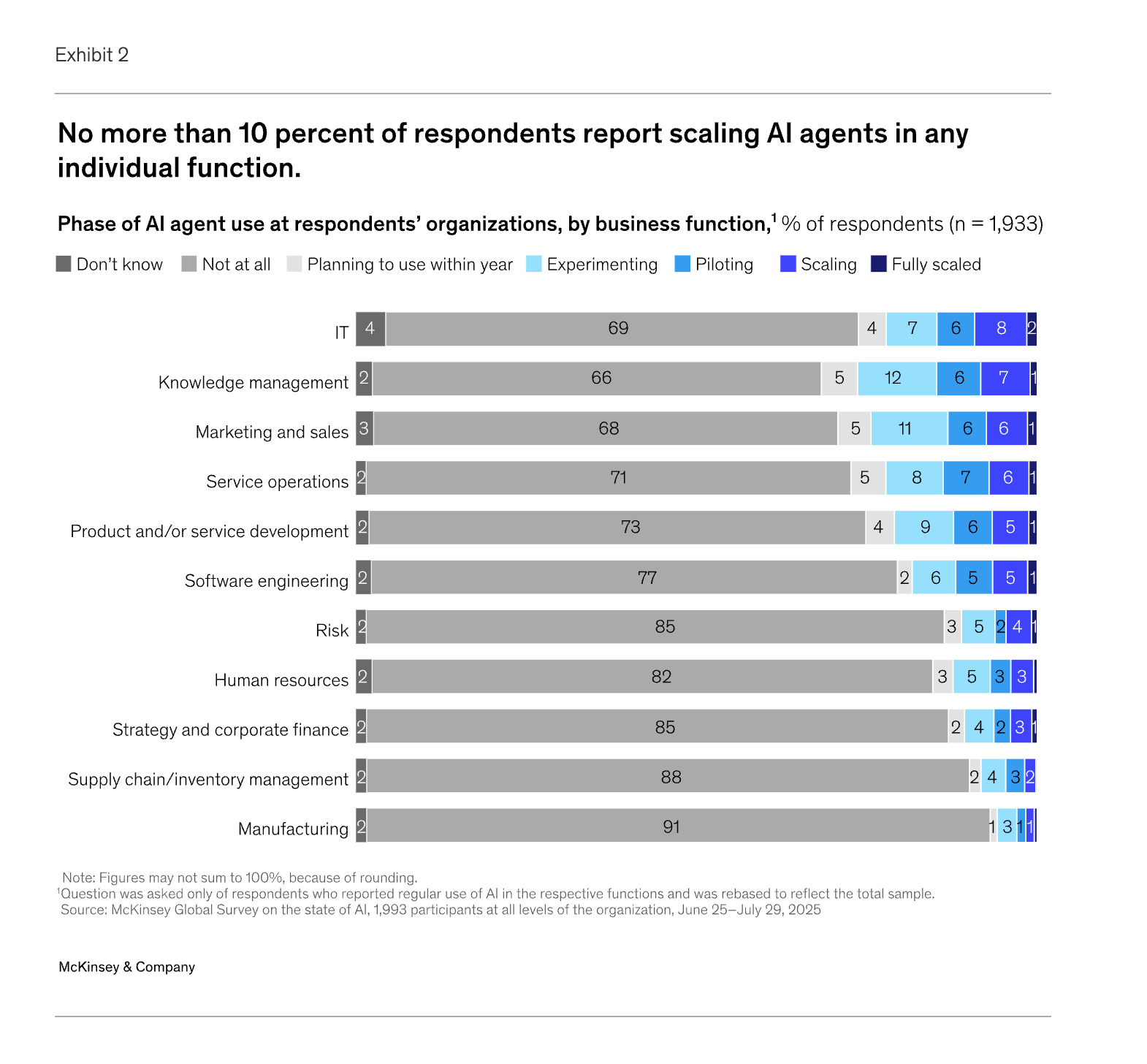
Chart shows the phase of AI agent adoption by business function. Manufacturing and supply chain/inventory management have the lowest scaling rates of any function surveyed, with 91% and 88% of respondents respectively reporting no AI agent use at all.
The Unknown Unknown
Here is what we have come to understand after working in AI strategy since its earliest days: the biggest capability AI has to offer your business is something you almost certainly cannot picture yet.
Not because you are not paying attention. Because no one who has not been building with AI at depth, over time, can fully comprehend what becomes possible. The gap is not about awareness. It is about exposure. Leaders who discover what AI can do at the workflow level are not just impressed. They are stunned. What they thought AI could do, and what it actually can do for their specific operation, are two very different things, and the distance between them is where the real opportunity lives.
Our team has been in this space long enough, and gone deep enough, to know what that distance looks like. And helping clients cross it is some of the most meaningful work we do.
Where to Start
If your team is already using AI in daily work, you are ahead of many. The next question is whether your organization has a strategy that connects those individual uses into something coherent, something that moves the whole business forward rather than just completing individual tasks faster.
Before committing significant time or capital to AI tools or platforms, it is important to pause to understand what problem you are actually trying to solve. Not the surface problem, but the underlying one. Is it slow inventory turns? Reactive pricing decisions? A sales team that lacks the right information at the right moment? The answer to that question should drive your AI strategy, not the other way around.
This is exactly what our 21-Day AI Strategy Sprint is designed to uncover. We map how work actually moves through your business, identify the three to seven highest-impact places to begin, and deliver a clear roadmap your team can act on. Not guesswork. Not a technology pitch. A plan built around your specific operation.
88% of organizations are using AI. 7% have made it work at scale. The difference is not the tool. It’s the strategy behind it.
To learn more about the AI Strategy Sprint, click here, or reach out to us at inquiry@hillandco.co.
*Source: McKinsey
